
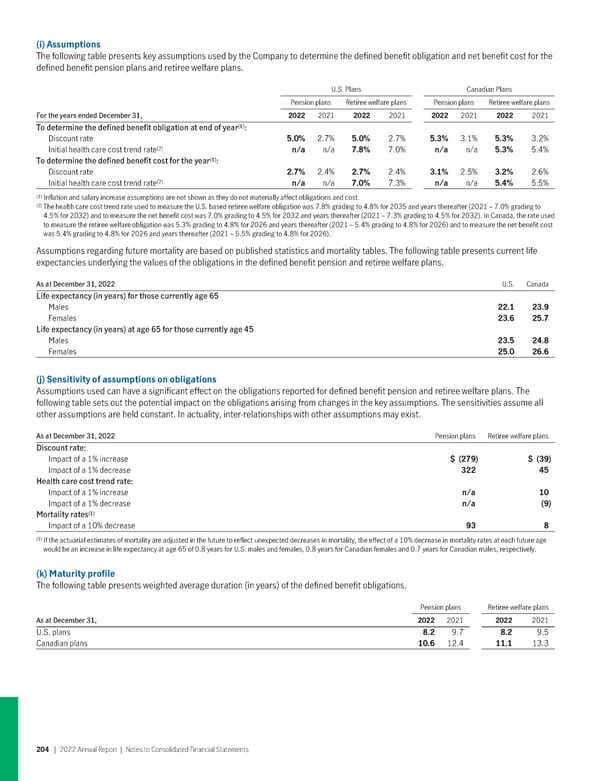
(i) Assumptions The following table presents key assumptions used by the Company to determine the defined benefit obligation and net benefit cost for the defined benefit pension plans and retiree welfare plans. U.S. Plans Canadian Plans Pension plans Retiree welfare plans Pension plans Retiree welfare plans For the years ended December 31, 2022 2021 2022 2021 2022 2021 2022 2021 To determine the defined benefit obligation at end of year(1): Discount rate 5.0% 2.7% 5.0% 2.7% 5.3% 3.1% 5.3% 3.2% (2) Initial health care cost trend rate n/a n/a 7.8% 7.0% n/a n/a 5.3% 5.4% To determine the defined benefit cost for the year(1): Discount rate 2.7% 2.4% 2.7% 2.4% 3.1% 2.5% 3.2% 2.6% (2) Initial health care cost trend rate n/a n/a 7.0% 7.3% n/a n/a 5.4% 5.5% (1) Inflation and salary increase assumptions are not shown as they do not materially affect obligations and cost. (2) The health care cost trend rate used to measure the U.S. based retiree welfare obligation was 7.8% grading to 4.8% for 2035 and years thereafter (2021 – 7.0% grading to 4.5% for 2032) and to measure the net benefit cost was 7.0% grading to 4.5% for 2032 and years thereafter (2021 – 7.3% grading to 4.5% for 2032). In Canada, the rate used to measure the retiree welfare obligation was 5.3% grading to 4.8% for 2026 and years thereafter (2021 – 5.4% grading to 4.8% for 2026) and to measure the net benefit cost was 5.4% grading to 4.8% for 2026 and years thereafter (2021 – 5.5% grading to 4.8% for 2026). Assumptions regarding future mortality are based on published statistics and mortality tables. The following table presents current life expectancies underlying the values of the obligations in the defined benefit pension and retiree welfare plans. As at December 31, 2022 U.S. Canada Life expectancy (in years) for those currently age 65 Males 22.1 23.9 Females 23.6 25.7 Life expectancy (in years) at age 65 for those currently age 45 Males 23.5 24.8 Females 25.0 26.6 (j) Sensitivity of assumptionsonobligations Assumptions used can have a significant effect on the obligations reported for defined benefit pension and retiree welfare plans. The following table sets out the potential impact on the obligations arising from changes in the key assumptions. The sensitivities assume all other assumptions are held constant. In actuality, inter-relationships with other assumptions may exist. As at December 31, 2022 Pension plans Retiree welfare plans Discount rate: Impact of a 1% increase $ (279) $ (39) Impact of a 1% decrease 322 45 Health care cost trend rate: Impact of a 1% increase n/a 10 Impact of a 1% decrease n/a (9) Mortality rates(1) Impact of a 10% decrease 93 8 (1) If the actuarial estimates of mortality are adjusted in the future to reflect unexpected decreases in mortality, the effect of a 10% decrease in mortality rates at each future age would be an increase in life expectancy at age 65 of 0.8 years for U.S. males and females, 0.8 years for Canadian females and 0.7 years for Canadian males, respectively. (k) Maturityprofile The following table presents weighted average duration (in years) of the defined benefit obligations. Pension plans Retiree welfare plans As at December 31, 2022 2021 2022 2021 U.S. plans 8.2 9.7 8.2 9.5 Canadian plans 10.6 12.4 11.1 13.3 204 | 2022AnnualReport | NotestoConsolidatedFinancialStatements
 2022 Annual Report Page 205 Page 207